USC Team Project, Fall 2025
Do People Undervalue Rewatching Films?
Extending Repeat-Experience Research for the Streaming Industry
Background
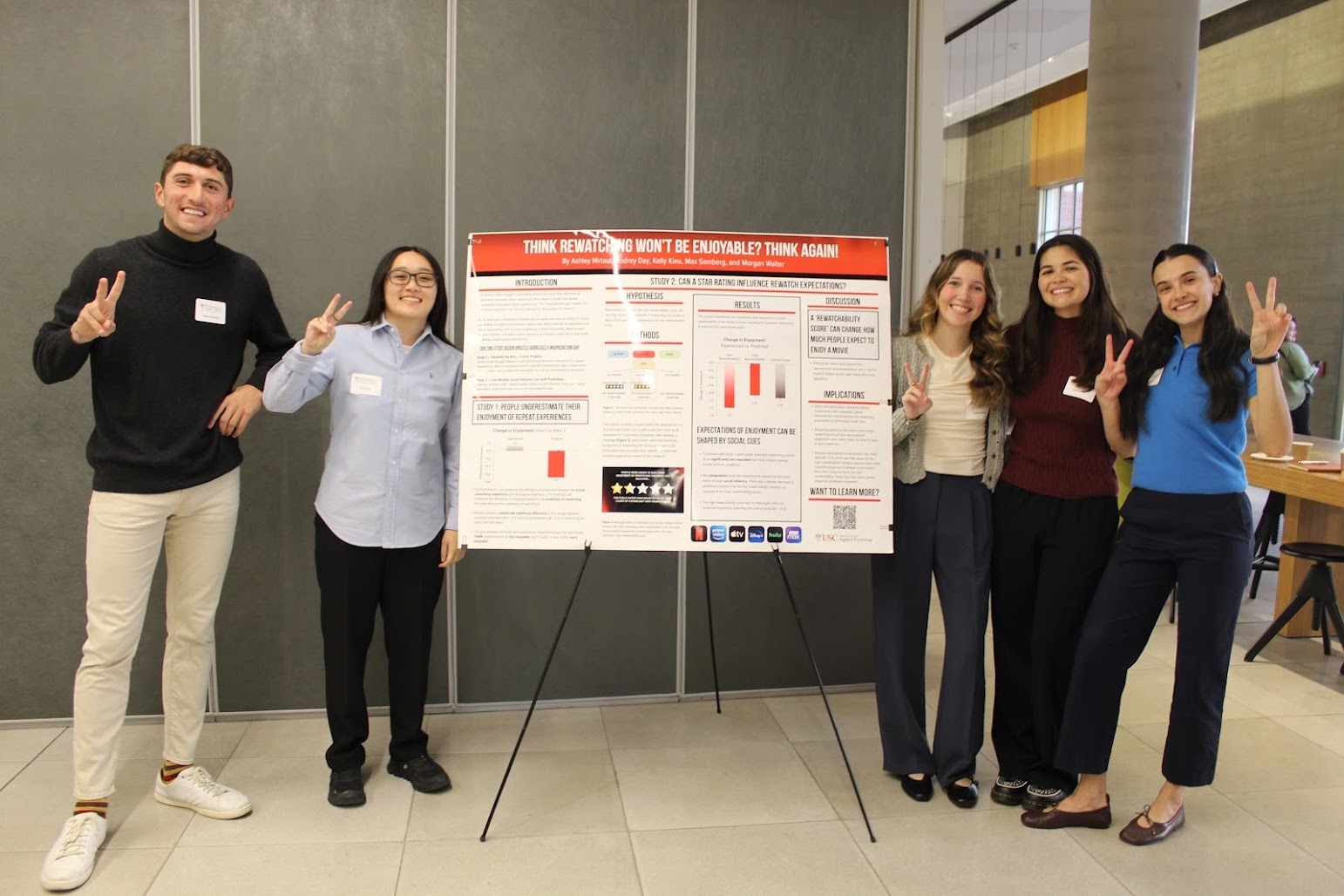
Tasked with standing on the shoulders of giants, we took inspiration from O'Brien (2019), which found that people underestimate how much they'll enjoy repeating an experience. Our team investigated whether this “rewatching penalty” holds for short films and, if so, whether showing viewers a public rewatchability rating could correct their misprediction. We framed the research question to have direct relevance to how streaming platforms surface and promote existing content.
Methods
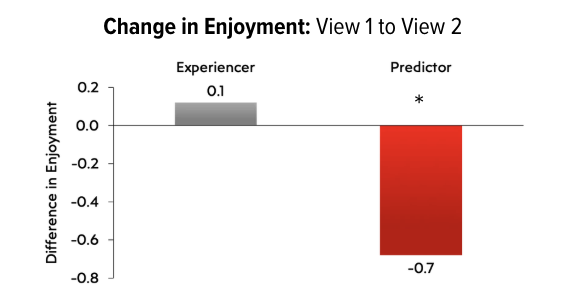
- Study 1: Establishing the Misprediction Problem(N=25)We used a between-subjects design: participants watched a short film, then either predicted their enjoyment of rewatching it (Predictors) or simply rewatched it (Experiencers) after a distractor task, rating enjoyment via Likert scale at each stage.
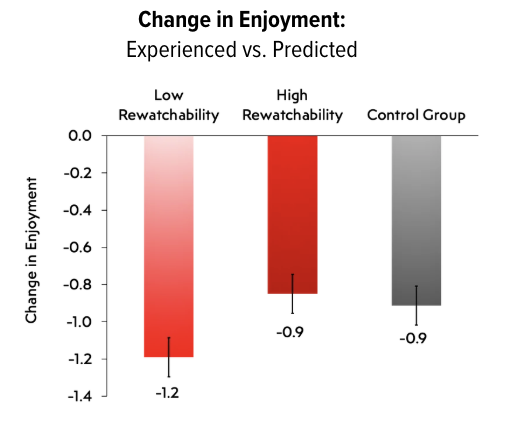
- Study 2: Test Whether Social Influence Can Shift Enjoyment Predictions(N=63)We extended this to real-world movies, randomly assigning participants to see a high, low, or no public “rewatchability score” before predicting their enjoyment of rewatching a film they'd just seen, testing whether social-proof cues could shift predicted enjoyment.
- Analysis using SPSS.
So What?
People enjoyed the second viewing more than they predicted, and a public rewatchability score couldn't shift that belief, so we recommended streaming platforms remind viewers of their own past enjoyment instead of showing aggregate ratings.